
Experimentation is fundamental to advancements in science and technology, particularly for optimizing agricultural machinery. This research aims to demonstrate the efficacy of the Design of Experiments (DOE) as a robust methodology in improving the performance of postharvest processing equipment, such as shelling, threshing, and decorticating machines used for postharvest operations in pods, seeds and nuts processing. Using a case study on a melon seed shelling machine, the Response Surface Methodology (RSM) was employed to optimize two key operating parameters: seed moisture content and motor speed after full. A Box-Behnken Design was selected for its efficiency, requiring 13 experimental runs. Analysis of Variance (ANOVA) confirmed the high significance of the developed quadratic model (F-value = 50.03, p < 0.001), which exhibited an excellent fit (adjusted R² = 95.33%). The results identified optimal parameters: a motor speed of approximately 1920 rpm and a moisture content of 24%, achieving a shelling efficiency of 93%. The second-best configuration yielded a motor speed of 2182 rpm and a moisture content of 22%, resulting in a shelling efficiency of 91%. Verification tests conducted at these optimal settings demonstrated an average relative error of only 0.65%, indicating strong alignment between the predicted and actual outcomes and thus validating the accuracy of the model. These findings confirm that RSM is an effective tool for optimizing the performance and productivity of agricultural machinery in the melon seed industry.
| Published in | International Journal of Mechanical Engineering and Applications (Volume 14, Issue 1) |
| DOI | 10.11648/j.ijmea.20261401.12 |
| Page(s) | 13-27 |
| Creative Commons |
This is an Open Access article, distributed under the terms of the Creative Commons Attribution 4.0 International License (http://creativecommons.org/licenses/by/4.0/), which permits unrestricted use, distribution and reproduction in any medium or format, provided the original work is properly cited. |
| Copyright |
Copyright © The Author(s), 2026. Published by Science Publishing Group |
Optimization, Full Factorial Design, Box-Behnken Design, ANOVA
Factor | Lower level (corner point) | Medium (Centre point) | High level (corner point) |
|---|---|---|---|
Motor speed (rpm) | 900 | 1500 | 2100 |
Moisture content (%) | 14 | 20 | 26 |
Runs | MR (rpm) | MC (%) |
|---|---|---|
1 | 1 | 1 |
2 | 1 | 1 |
3 | -1 | -1 |
4 | -1 | -1 |
5 | -1 | 1 |
6 | -1 | 1 |
7 | 1 | -1 |
8 | 1 | -1 |
9 | 0 | 0 |
10 | 0 | 0 |
11 | 0 | 0 |
Runs | MR (rpm) | MC (%) | SE (%) |
|---|---|---|---|
1 | 1 | 1 | 95.9 |
2 | 1 | 1 | 96.5 |
3 | -1 | -1 | 54.1 |
4 | -1 | -1 | 55.7 |
5 | -1 | 1 | 73.58 |
6 | -1 | 1 | 73.95 |
7 | 1 | -1 | 75.3 |
8 | 1 | -1 | 75.9 |
9 | 0 | 0 | 86,12 |
10 | 0 | 0 | 86,96 |
11 | 0 | 0 | 86,45 |
Source | DF | Adj SS | Adj MS | F-Value | P-Value |
|---|---|---|---|---|---|
Model | 4 | 0,199 | 0,050 | 1447,13 | 0,000 |
MR | 1 | 0,093 | 0,093 | 2700,93 | 0,000 |
MC | 1 | 0,078 | 0,078 | 2260,89 | 0,000 |
MR ⨉ MC | 1 | 0,000 | 0,000 | 4,37 | 0,082 |
Curvature | 1 | 0,028 | 0,028 | 822,31 | 0,000 |
Error | 6 | 0,000 | 0,000 | ||
Total | 10 | 0,200 |
Runs | MR (rpm) | MC (%) | SE (%) |
|---|---|---|---|
1 | 2100 | 26 | 96,5 |
2 | 2100 | 14 | 75,3 |
3 | 900 | 14 | 54,1 |
4 | 900 | 26 | 73,58 |
5 | 651,5 | 20 | 58,89 |
6 | 2348,5 | 20 | 82,49 |
7 | 1500 | 11,5 | 58,74 |
8 | 1500 | 28,5 | 82,65 |
9 | 1500 | 20 | 86,52 |
10 | 1500 | 20 | 86,29 |
11 | 1500 | 20 | 85,54 |
12 | 1500 | 20 | 86,77 |
13 | 1500 | 20 | 86,96 |
Source | DF | Adj SS | Adj MS | F-Value | P-Value |
|---|---|---|---|---|---|
Model | 5 | 0,202 | 0,040 | 50,03 | 0,000 |
MR | 1 | 0,075 | 0,075 | 93,10 | 0,000 |
MC | 1 | 0,069 | 0,069 | 86,03 | 0,000 |
MR ⨉ MR | 1 | 0,032 | 0,032 | 40,11 | 0,000 |
MC ⨉ MC | 1 | 0,032 | 0,032 | 40,08 | 0,000 |
MR ⨉ MC | 1 | 0,000 | 0,000 | 0,09 | 0,771 |
Error | 7 | 0,006 | 0,001 | ||
Lack-of-Fit | 3 | 0,006 | 0,002 | 60,59 | 0,001 |
Pure Error | 4 | 0,000 | 0,000 | ||
Total | 12 | 0,207 |
Term | S | R-sq | R-sq (Adj) | R-sq (Pred) |
|---|---|---|---|---|
Values | 0,028 | 97,28% | 95,33% | 80,97% |
Term | S | R-sq | R-sq (Adj) | R-sq (Pred) |
|---|---|---|---|---|
Values | 0,027 | 97,24% | 95,86% | 86,94% |
Name | Goal | Lower Limit | Upper Limit | Lower Weight | Upper Weight |
|---|---|---|---|---|---|
MS | in range | 900 | 2100 | 1 | 1 |
MC | in range | 0,14 | 0,26 | 1 | 1 |
SE | maximize | 0,9 | 0,965 | 1 | 1 |
Solution | MS (rpm) | MC (%) | SE (%) | CD |
|---|---|---|---|---|
1 | 1920,0 | 24,0 | 93,0 | 0,607 |
2 | 2182,0 | 22,2 | 91,1 | 0,229 |
3 | 1646,2 | 26,0 | 90,9 | 0,172 |
4 | 1660,8 | 26,2 | 90,8 | 0,168 |
5 | 1572,0 | 25,3 | 90,4 | 0,076 |
Test | ESE (%) | PSE (%) | Error |
|---|---|---|---|
1 | 91.5 | 93,0 | 1,61 |
2 | 92.0 | 93,0 | 1,08 |
3 | 92.8 | 93,0 | 0,22 |
4 | 93.5 | 93,0 | -0,54 |
5 | 92.2 | 93,0 | 0,86 |
Average | 92,4 | 93 | 0,65 |
MR | Motor Revolution |
MC | Moisture Content |
SE | Shelling Efficiency |
ESH | Experimental Shelling Efficiency |
PSE | Predicted Shelling Efficiency |
CD | Composite Desirability |
| [1] | A. A. Kabir and O. K. Fedele, "A review of shelling, threshing, de-hulling and decorticating machines," J Agri Res., vol. 3, pp. 1: 000148, 2018, |
| [2] | Agri Frontier, 2025, Mercy Ndunge and Raphael Maingi. Available: |
| [3] | O. Oduma, S. Oluka, N. Nwakuba and D. Ntunde, "Agricultural field machinery selection and utilization for improved farm operations in South-East Nigeria: A review," Agr. Eng., vol. 3, pp. 44–58, 2019, |
| [4] | J. S. Adlin, A. ayanthiladevi, "AgriYield-ML: Enhancing agricultural productivity through machine learning: a model for accurate crop yield prediction," Journal of Engineering Sciences, vol. 53, no. 5, pp. 155-169, 2025, |
| [5] | European Comission. Supporting policy with scientific evidence. Available: |
| [6] | T. L. Odong, J. S. Tenywa and M. Nabasirye, "Revisiting application of statistics in Agricultural Research in sub-Saharan Africa: Entry points for improvement," African Crop Science Journal, vol. 27, no. 3, pp. 529 - 544, 2019, |
| [7] | Y. Li, B. Zhao, W. Zhang, L. Wei and L. Zhou, "Evaluation of agricultural machinery operational benefits based on semi-supervised learning." Agriculture, vol. 12, no. 12: 2075, 2022, |
| [8] | V. A. Tirado-Kulieva, M. Sánchez-Chero, M. V. Yarlequé G. F. V. Aguilar, G. Carrión-Barco and A. G. Y. Santa Cruz, "An overview on the use of response surface methodology to model and optimize extraction processes in the food industry." Current Research in Nutrition and Food Science Journal, vol. 9, no. 3, pp. 745-754, 2021, |
| [9] | A. I. Khuri, "Response surface methodology and its applications in agricultural and food sciences," Biom. Biostat. Int. J., vol. 5, no. 5, pp. 155-163, |
| [10] | B. Durakovic, "Design of experiments application, concepts, examples: State of the art." Periodicals of Engineering and Natural Sciences, vol. 5, no. 3, pp. 421-439, 2017. |
| [11] | A. A. Dar, P. Yadav and T. Wangmo, "Optimizing processes and products: The role of DOE," Insight-Statistics, vol. 7, no. 1, pp. 644-644, 2024, |
| [12] | S. Lamidi, N. Olaleye, Y. Bankole, A. Obalola, E. Aribike and I. Adigun, "Applications of response surface methodology (RSM) in product design, development, and process optimization," IntechOpen, 2022. |
| [13] | V. Kamalakannan, S. Rajaram, J. Iyyadurai and F. S. Arockiasamy, "Fundamental study on influence of independent factors on response variable using response surface methodology and Taguchi method," Engineering Proceedings, vol. 61, no. 1, 37, 2024, |
| [14] | J. M. Pais-Chanfrau, J. Núñez-Pérez, R. del Carmen Espin-Valladares, M. V. Lara-Fiallos and L. E. Trujillo-Toledo, "Uses of the response surface methodology for the optimization of agro-industrial processes," Response Surface Methodology in Engineering Science, IntechOpen, 2021, |
| [15] | M. A. Hadiyat, B. M. Sopha and B. S. Wibowo, "Response surface methodology using observational data: a systematic literature review," Applied Sciences, vol. 12, no. 20, 10663, 2022, |
| [16] | A. I. Taiwo, S. A. Agboluaje and W. A. Lamidi, "Application of response surface method (RSM) and central composite design (CENTRAL COMPOSITE DESIGN) for optimization of cassava yield," Interdisciplinary Research Review, vol. 14, no. 6, pp. 62 – 69, 2019, |
| [17] | K. S. Abasiekong, T. U. Nwabueze and E. N. Akobundu, "Optimization of African Breadfruit Based Complementary Food Using Mixture Response Surface Methodology," Asian Food Science Journal, vol. 22, no. 4, pp. 1-9, 2023, |
| [18] | A. V. Uday Kiran Kandala, D. G. Solomon and J. J. Arulraj, "Advantages of Taguchi method compared to response surface methodology for achieving the best surface finish in wire electrical discharge machining (WEDM)," Journal of Mechanical Engineering, vol. 19, no. 1, pp. 185-200, 2022. |
| [19] | O. J. Chizoba and B. A Kyari, "Response surface methodology and Taguchi method based applications–a review," Glob J Eng Technol Adv, vol. 5, no. 2, pp. 047-056, 2020, |
| [20] | N. Botha, H. M. Inglis, R. Coetzer and F. J. W. Labuschagne, "Statistical Design of Experiments: An introductory case study for polymer composites manufacturing applications," MATEC Web of Conferences, 347, 00028, 2021, |
| [21] | T. J. Robinson, C. M. Borror and R. H. Myers, “Robust parameter design: a review,” Quality and reliability engineering international, vol. 20, no. 1, pp. 81-101, 2004, |
| [22] | V. P. Astakhov, "Design of experiment methods in manufacturing: Basics and practical applications," Statistical and computational techniques in manufacturing, pp. 1-54, 2012, Berlin, Heidelberg: Springer Berlin Heidelberg. |
| [23] | D. Nikhila Sri, R. Kottapalli, A. Pavani, C. Ganteda, E. Gouthami, A. Abd-Elmonem and A. H. Almaliki, "Comparison between response surface methodology and Taguchi method for dyeing process parameters optimization in fabric manufacturing by empirical planning," Scientific Reports, vol. 15, no. 1, 10209, 2025, |
| [24] | B. Y. Alashwal, M. S. Bala, A. Gupta and T. Soubam, "Strategies using of Design of Experiments (DOE) techniques: In view of a Review, " Maejo International Journal of Energy and Environmental Communication, vol. 3, no. 3, pp. 1–5, 2021. |
| [25] | O. G. Toapanta, J. Paredes, M. Meneses and G. Salinas, "Validation of DOE factorial/taguchi/surface response models of mechanical properties of synthetic and natural Fiber reinforced epoxy matrix hybrid material," Polymers, vol. 16, no. 14, 2051, 2024, |
| [26] | M. H. Lee, H. Mohamed and M. Sarahintu, "Determining the effects of scenario metrics on the performance of dynamic source routing using taguchi approach," Matematika, vol. 23, no. 2, pp. 121-132, 2007. |
| [27] | K. Tsapi and M. Ekokem (2026). Optimizing Melon Seed Decortication: A Taguchi-Based Approach for Single and Multi-Objective Performance. Journal of Mechanical Engineering, 3(1), 17, |
| [28] | L. O. Agberegha, E. Emagbetere, F. Onoroh, F. I. Ashiedu, A. Akene, F. I. Idubor and B. U. Oreko, "Design and Fabrication of a Melon (Egusi) Decorticating Machine," Saudi Journal of Engineering and Technology, vol. 6, no. 11, pp. 432-444, 2021. |
| [29] | T. K. Tsapi, S. M. Bisong and F. B. Soh, "Optimal settings of a melon seed sheller using statistical design of experiments," International Journal of Mechanical Engineering Technologies and Applications, vol. 5, no. 1, pp. 38-50, 2024, |
| [30] | S. S. Sobowale, J. A. Adebiyi and O. A. Adebo, "Design, construction and performance evaluation of a melon seeds sheller," J Food Process Technol, vol. 6, no. 7, 1000463, 2015, |
| [31] | D. D. Yusuf, M. L. Attanda and H. O. Yusuf, "Multi-Objective Optimization of Shelling Process of an Engine-Operated Melon (Citrullus Laenatus Kuntze) Sheller," Arid Zone Journal of Engineering, Technology and Environment, vol. 21, no. 1, pp. 210-227. 2025. |
| [32] | H. D. Olusegun and A. S. Adekunle, "The design, construction and testing of melon sheller," Global journal of Engineering and Technology, vol. 1, no. 4, pp. 473-481, 2008. |
| [33] | C. Osuji, C. Uche, M. Iheagwara, C. Ofoedu, G. Omeire, A. Nwakaudu and I. Ozumba, "The effect of mechanized shelling and packaging on the quality of melon seeds," Potravinarstvo Slovak Journal of Food Sciences, vol. 17, no. 1, pp. 565-580, 2023, |
| [34] | O. O. Oluwole and A. S. Adedeji, "Effect of moisture content and inner drum rotation speed on the shelling performance of a melon sheller," Journal of Science and Technology, vol. 2, no. 2, pp. 21-26, 2012. |
| [35] | R. Sanjeevi, G. A. Kumar and B. R. Krishnan, "Optimization of machining parameters in plane surface grinding process by response surface methodology," Materials Today: Proceedings, vol. 37, pp. 85-87, 2021, |
| [36] | M. Heshmat and Y. Abdelrhman, “ANOVA and regression model of slurry erosion parameters of a polymeric spray paint film,” International Journal of Materials Engineering Innovation, vol. 11, no. 3, pp. 198-211, 2020. |
| [37] | M. Heshmat and M. Adel, "Investigating the effect of hot air polishing parameters on surface roughness of fused deposition modeling PLA products: ANOVA and regression analysis," Progress in Additive Manufacturing, vol. 6, no. 4, pp. 679-687, 2021. |
| [38] | S. K. A. Al Sharifi, M. A. Aljibouri and M. A. Taher, "Effect of threshing machines, rotational speed and grain moisture on corn shelling," Bulgarian Journal of Agricultural Science, vol. 25, no. 2, pp. 243-255, 2019. |
| [39] | Lupu, M. I., Pădureanu, V., Canja, C. M., & Măzărel, A. "The effect of moisture content on grinding process of wheat and maize single kernel." IOP Conference Series: Materials Science and Engineering, vol. 145, no. 2. IOP Publishing, 2016, |
| [40] | R. H. Myers, D. C., Montgomery and C. M. Anderson-Cook, “Response surface methodology: Process and product optimization using designed experiments (4th ed.), 2016, John Wiley & Sons. |
| [41] | A. I. Khuri and S. Mukhopadhyay, “Response surface methodology,” Wiley interdisciplinary reviews: Computational statistics, vol. 2, no. 2, 2010, 128-149. |
| [42] | T. Ipilakyaa, M. Iorbee, I. Tyohemba, “Design, construction and performance evaluation of a motorized and manually operated groundnut sheller,” International Journal of Engineering and Science, vol. 11, no. 5, pp. 10-17, 2021. |
| [43] | Jeffi, N., & Hamid, N. H. A. "Comparison of Central Composite and Box-Behnken design in optimization of turbidity removal using nanocellulose filter paper (Neolarmarckia cadamba)," Progress in Engineering Application and Technology, vol. 2, no. 1, pp. 350-360, 2021. |
APA Style
Kevin, T. T., Nidelle, N. P., Belinda, M. E., Bertin, S. F. (2026). Experimental Study and Numerical Analysis of a Melon Seed Shelling Process Based on Response Surface Methodology. International Journal of Mechanical Engineering and Applications, 14(1), 13-27. https://doi.org/10.11648/j.ijmea.20261401.12
ACS Style
Kevin, T. T.; Nidelle, N. P.; Belinda, M. E.; Bertin, S. F. Experimental Study and Numerical Analysis of a Melon Seed Shelling Process Based on Response Surface Methodology. Int. J. Mech. Eng. Appl. 2026, 14(1), 13-27. doi: 10.11648/j.ijmea.20261401.12
AMA Style
Kevin TT, Nidelle NP, Belinda ME, Bertin SF. Experimental Study and Numerical Analysis of a Melon Seed Shelling Process Based on Response Surface Methodology. Int J Mech Eng Appl. 2026;14(1):13-27. doi: 10.11648/j.ijmea.20261401.12
@article{10.11648/j.ijmea.20261401.12,
  author = {Tsapi Tchoupou Kevin and Nguegni Pefoufe Nidelle and Magnou Ekokem Belinda and Soh Fotsing Bertin},
  title = {Experimental Study and Numerical Analysis of a Melon Seed Shelling Process Based on Response Surface Methodology},
  journal = {International Journal of Mechanical Engineering and Applications},
  volume = {14},
  number = {1},
  pages = {13-27},
  doi = {10.11648/j.ijmea.20261401.12},
  url = {https://doi.org/10.11648/j.ijmea.20261401.12},
  eprint = {https://article.sciencepublishinggroup.com/pdf/10.11648.j.ijmea.20261401.12},
  abstract = {Experimentation is fundamental to advancements in science and technology, particularly for optimizing agricultural machinery. This research aims to demonstrate the efficacy of the Design of Experiments (DOE) as a robust methodology in improving the performance of postharvest processing equipment, such as shelling, threshing, and decorticating machines used for postharvest operations in pods, seeds and nuts processing. Using a case study on a melon seed shelling machine, the Response Surface Methodology (RSM) was employed to optimize two key operating parameters: seed moisture content and motor speed after full. A Box-Behnken Design was selected for its efficiency, requiring 13 experimental runs. Analysis of Variance (ANOVA) confirmed the high significance of the developed quadratic model (F-value = 50.03, p < 0.001), which exhibited an excellent fit (adjusted R² = 95.33%). The results identified optimal parameters: a motor speed of approximately 1920 rpm and a moisture content of 24%, achieving a shelling efficiency of 93%. The second-best configuration yielded a motor speed of 2182 rpm and a moisture content of 22%, resulting in a shelling efficiency of 91%. Verification tests conducted at these optimal settings demonstrated an average relative error of only 0.65%, indicating strong alignment between the predicted and actual outcomes and thus validating the accuracy of the model. These findings confirm that RSM is an effective tool for optimizing the performance and productivity of agricultural machinery in the melon seed industry.},
 year = {2026}
}
TY  - JOUR
T1  - Experimental Study and Numerical Analysis of a Melon Seed Shelling Process Based on Response Surface Methodology
AU  - Tsapi Tchoupou Kevin
AU  - Nguegni Pefoufe Nidelle
AU  - Magnou Ekokem Belinda
AU  - Soh Fotsing Bertin
Y1  - 2026/02/27
PY  - 2026
N1  - https://doi.org/10.11648/j.ijmea.20261401.12
DO  - 10.11648/j.ijmea.20261401.12
T2  - International Journal of Mechanical Engineering and Applications
JF  - International Journal of Mechanical Engineering and Applications
JO  - International Journal of Mechanical Engineering and Applications
SP  - 13
EP  - 27
PB  - Science Publishing Group
SN  - 2330-0248
UR  - https://doi.org/10.11648/j.ijmea.20261401.12
AB  - Experimentation is fundamental to advancements in science and technology, particularly for optimizing agricultural machinery. This research aims to demonstrate the efficacy of the Design of Experiments (DOE) as a robust methodology in improving the performance of postharvest processing equipment, such as shelling, threshing, and decorticating machines used for postharvest operations in pods, seeds and nuts processing. Using a case study on a melon seed shelling machine, the Response Surface Methodology (RSM) was employed to optimize two key operating parameters: seed moisture content and motor speed after full. A Box-Behnken Design was selected for its efficiency, requiring 13 experimental runs. Analysis of Variance (ANOVA) confirmed the high significance of the developed quadratic model (F-value = 50.03, p < 0.001), which exhibited an excellent fit (adjusted R² = 95.33%). The results identified optimal parameters: a motor speed of approximately 1920 rpm and a moisture content of 24%, achieving a shelling efficiency of 93%. The second-best configuration yielded a motor speed of 2182 rpm and a moisture content of 22%, resulting in a shelling efficiency of 91%. Verification tests conducted at these optimal settings demonstrated an average relative error of only 0.65%, indicating strong alignment between the predicted and actual outcomes and thus validating the accuracy of the model. These findings confirm that RSM is an effective tool for optimizing the performance and productivity of agricultural machinery in the melon seed industry.
VL  - 14
IS  - 1
ER  -
Department of Mechanical and Industrial Engineering, University of Bamenda, Bamenda, Cameroon
Department of Mechanical and Industrial Engineering, University of Bamenda, Bamenda, Cameroon
Department of Mathematics and Computer Science, University of Bamenda, Bamenda, Cameroon
Department of Mechanical and Production Engineering, University of Dschang, Badjoun, Cameroon
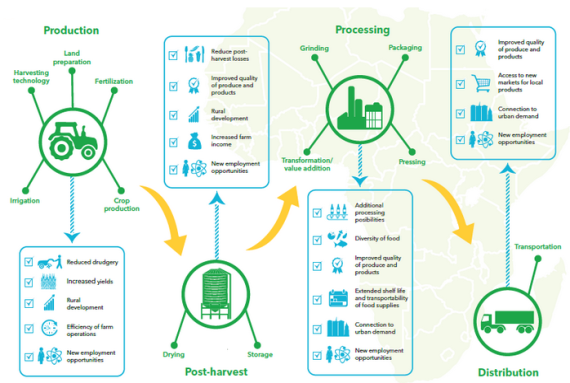
Figure 1. Benefits of mechanization along the agricultural value chains [2].
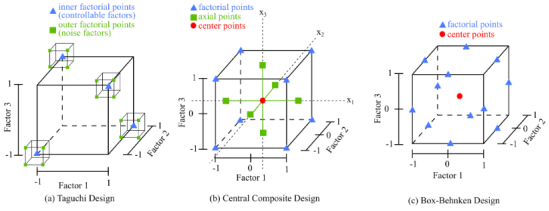
Figure 2. Graphical representation of the 3-factor design space for the different RSM designs [20].
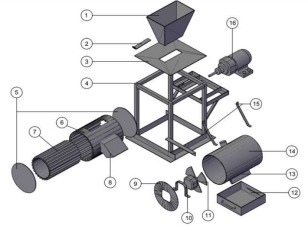
Figure 3. Sketch and line diagram of the melon sheller [27]: 1 – Hopper; 2 – sight glass; Pulley; 3 – Frame cover; 4 –Housing frame; 5 – Disc cover; 6- Shelling drum; 7- Shelling disc; 8- Outlet for shelled melon for melon; 9- Blower guide; 10- Guide; 11- Fan; 12- Outlet plate; 13- Blower outlet; 14-Blower; 15- Hub support; 16- Electric mower.
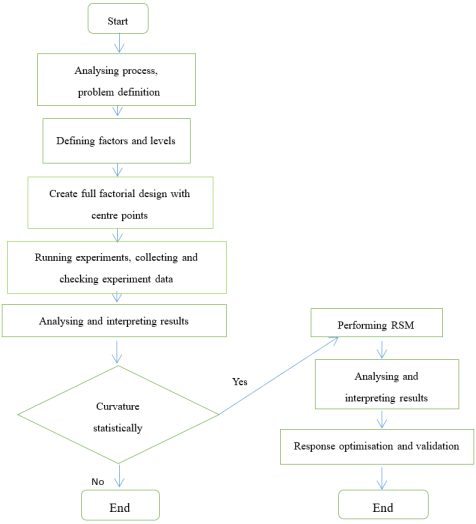
Figure 4. RSM flow chart.
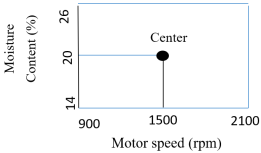
Figure 5. Two factors two levels full factorial design with centre point.
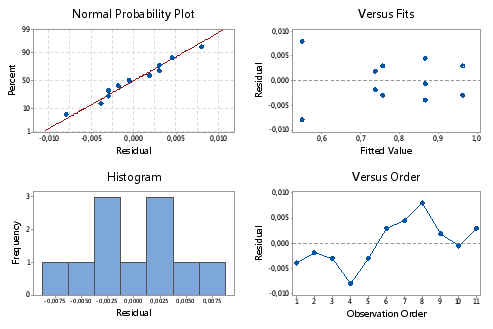
Figure 6. Residual plot for shelling efficiency.
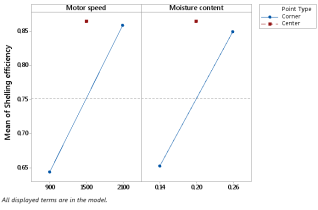
Figure 7. Main effects plots for shelling efficiency.
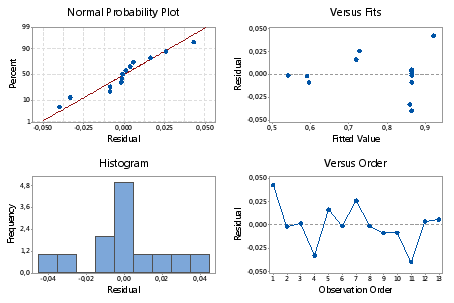
Figure 8. Residual plot for shelling efficiency.
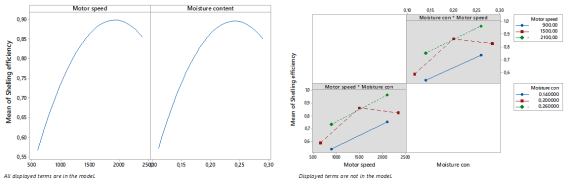
Figure 9. Main effects and interaction plots.
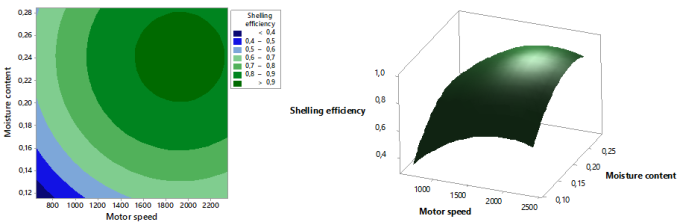
Figure 10. Contour plot (left) and surface plot (right).




 Share This Article
 Twitter
 Linked In
 Facebook
 Copy
Copy Download